Tether Built a Conglomerate. Most People Are Still Calling It a Stablecoin.
- Tether created the stablecoin category: roughly $300 billion today, guided toward $3 trillion by 2030 by the US Treasury Secretary himself.
- Its reserves ($187.8B in assets against roughly $184.6B of USDT in circulation, with $4.1B to spare) make it one of the top 20 holders of US government debt, ahead of Germany, the UAE, and Australia.
- The stablecoin is only the front door. Tether now organizes its work into five branded divisions it calls pillars: Tether Finance, Tether Power (mining), Tether Data (private messaging and AI), Tether Education, and Tether Evo (frontier tech and neurotechnology). A separate, much larger vehicle called Tether Investments runs the rest of Tether's 100+ company equity portfolio. Around them sits a wider USDT economy of chains and apps Tether doesn't own.
- The growth playbook is hyperlocalization, Tether's own term: local teams and localized products, with tether.wallet targeting 150 million users within 18 months.
- What I would focus on: turning WDK into a real developer platform, agentic payments, in-wallet merchant discovery, a Tether-backed insurance fund for onchain finance, tokenized equities, privacy, university partnerships, and putting Tether's megaphone behind ecosystem builders.
- And the classic Tether FUD? It hasn't survived contact with the numbers: a $7 billion-in-48-hours redemption stress test passed in May 2022, and in August 2026 Tether closed its audit gap outright, with KPMG's first full financial-statement audit coming back with an unqualified opinion.
"Tether's mission has always been to build trust through action, not promises." Paolo Ardoino, CEO, Tether's recurring formal mission line
In November 2014, a company almost nobody had heard of quietly rebranded from "Realcoin" to "Tether." Bitfinex started trading it two months later. That same month, I registered Bithope Foundation in Bulgaria, one of Europe's first Bitcoin-only charities.
I've used USDT and lived inside this industry since 2013. Like most people in crypto, what I followed about Tether over the years was the same mix everyone did: the accusations, the adoption headlines, the FUD moving markets, the good and the bad. Meanwhile I was fighting my own local battles with Bitcoin ignorance, with regulation, and for adoption in Bulgaria, while Tether was quietly growing and spreading across entire continents. My goal with this piece is to map that ecosystem and share it: something massive that somehow feels both part of the crypto space and strangely distant from it.
Ardoino's line above, trust through action rather than promises, turns out to be a principle I've followed myself without ever putting it in those words: building Bithope since 2014 and serving the NGO sector with campaigns as far away as South America and Nigeria, running Sofia Crypto Meetup for over a decade, building some of Bulgaria's largest crypto conferences, and doing heavy, hands-on product and marketing work for crypto protocols I actually believed in. A decade of building trust through action. So this is partly a map, and partly a recognition of a way of working I know from the inside.
The Facts
Strip out every opinion about Tether, for or against, and a few numbers remain that nobody seriously disputes. Start there.
- Tether created the stablecoin category. That category is now worth roughly $300 billion and, per US Treasury Secretary Scott Bessent's own public guidance, is on a path toward $3 trillion by 2030.
- Tether alone holds roughly $140.6 billion in US Treasuries and Treasury-backed instruments (about $115 billion of it in direct T-bills), enough to rank it around the 18th largest holder of US government debt in the world, ahead of Germany, the UAE, and Australia.
- Every one of those dollars does double duty: propping up demand for US debt, and giving people in countries with weak currencies a way to hold and move real dollars.
"Tether has done more to deliver on financial inclusion, and an actual hedge against currency debasement, than Bitcoin itself has. Not instead of Bitcoin's story. Because of it." My own claim
The rest of this piece is the evidence for that claim, pillar by pillar.
Where the money sits: reserves, and the transparency question
The obvious first question about any stablecoin is what actually backs it. The breakdown below uses the figures from Tether's most recent quarterly attestation: its Financial Figures and Reserves Report as of 30 June 2026, prepared by Tether's board and given a reasonable-assurance opinion by BDO Advisory Services S.r.l. (BDO's Milan firm) under ISAE 3000R. These are attested figures, not an aggregator's estimate.
| Reserve component | Share | Notes |
|---|---|---|
| Cash & US Treasuries | ~75% (~$140.6B) | About $115B in direct T-bills, the rest in overnight and term reverse repos, non-US T-bills, and cash. Ranks Tether an informal top-20 holder of US sovereign debt |
| Gold | ~10% (~$18.8B) | Physical LBMA bars, valued at $4,008.02/oz; Tether expanded holdings to more than 146 tons this quarter |
| Bitcoin | ~3.1% (~$5.8B) | The single line item S&P flagged hardest; dollar value fell with BTC's price even as Tether kept adding to its holdings, now 98,932 BTC |
| Secured loans & other | ~12% (~$22.5B) | Secured loans fell to ~$13.5B (~7.2%), down 15% quarter over quarter, the bucket outside analysts focus on hardest; the rest is ~$9.0B in public equities, other investments, and corporate bonds |
Total reserves: $187.75B in total assets against $183.64B in total liabilities, leaving $4.11B in excess reserves, backing roughly $184.6B of USDT in circulation. Figures per Tether's Q2 2026 attestation (BDO Advisory Services S.r.l., a reasonable-assurance engagement under ISAE 3000R, as of 30 June 2026, authorized by Tether's board on 31 July 2026). Still not a full independent financial-statement audit.
"In our opinion, the Financials Figures and Reserves Report, as prepared by the Board of Directors of the Company as of 30 June 2026, is, in all material respects, fairly presented in accordance with the criteria, including Management's Key Accounting Policies, set out therein." BDO Advisory Services S.r.l., reasonable-assurance opinion under ISAE 3000R, 31 July 2026
The open questions are real too, and they have a date and a rating agency attached.
- November 2025: S&P Global downgraded USDT's stability rating to "weak," its bottom tier, citing rising bitcoin/gold/secured-loan exposure and "persistent gaps in disclosure" on custodians and counterparties.
- Update, August 2026: that gap just closed. KPMG, engaged back in March 2026 alongside PwC, completed Tether's first full independent financial-statement audit in August 2026, with an unqualified opinion. Full breakdown right below.
- The excess-reserve buffer roughly halved. From $8.2B (as of 31 March 2026) to $4.1B (as of 30 June 2026). Tether's own equity reconciliation attributes the drop over that stretch to a $3.17B negative financial result, partly offset by $943M in net capital movements. Reserves still comfortably exceed liabilities, but by a much thinner margin than a quarter ago, worth watching in the next attestation.
"USDT has operated for more than a decade and has consistently maintained full resilience through banking crises, exchange failures, liquidity shocks, and extreme market volatility." Tether, in its official response to the S&P downgrade
Tether says it "strongly disagrees" with the S&P rating. CEO Paolo Ardoino has separately framed the downgrade as traditional finance's discomfort with digital assets generally, pointing to USDT's peg holding through real stress, 2022's chain of collapses and multiple deep bear markets, as the more meaningful test. I come back to this argument, and to what the market itself has been signaling about it, in the FUD section near the end of this piece.
The first audit: what KPMG actually checked
On 13 August 2026, Tether announced that KPMG U.S. had completed its first full independent financial-statement audit, closing the exact gap the bullet above used to describe. The entity audited was Tether International, S.A. de C.V., covering the fiscal year ended 31 December 2025, and the result was an unqualified opinion: no exceptions, no reservations.
This is a different, and stronger, claim than the quarterly attestations described above. BDO's ISAE 3000R work attests to a specific reserves report on a rolling quarterly basis. KPMG's audit examined Tether's full financial statements under US GAAP, the same bar public companies clear every year.
| What KPMG did | Detail |
|---|---|
| Entity audited | Tether International, S.A. de C.V. |
| Auditor | KPMG U.S. (Big Four) |
| Audit type | Full independent financial-statement audit, not a limited or reasonable-assurance attestation |
| Standards | AICPA auditing standards; financials prepared under US GAAP |
| Period covered | Fiscal year ended 31 December 2025 |
| Statements examined | Balance sheet, income statement, cash-flow statement, statement of changes in equity |
| Verification method | Physical inspection and count of every individual gold bar in reserves; independent substantive testing of transactions, systems, ownership records, valuations, and counterparties |
| Opinion issued | Unqualified (clean): no exceptions or reservations |
| Headline result | Reserves exceeded liabilities by $6.814 billion as of 31 December 2025 |
Some of crypto's loudest voices built years of audience trust on the premise that this exact audit could never happen, or that it would find the reserves weren't really there. Bitfinex'ed, the pseudonymous X account that has needled Tether since 2017, built entire threads on that premise. Coffeezilla, one of YouTube's largest scam-investigation channels, ran his own audience through the same doubts. Zeke Faux devoted much of his Bloomberg book Number Go Up to chasing the same question across three continents. None of them were being irrational: "trust us" really was the operative phrase behind hundreds of billions of dollars, and skepticism of a claim that size was the correct default for years. What changes here isn't that the skeptics were foolish. It's that the specific, falsifiable claim they were making, that the reserves might not really be there, now has a Big Four signature attached to its rebuttal.
"Today, more than 650 million users across all emerging markets continue to rely on Tether daily, choosing USD₮ as their currency, for their life savings, for their commerce, for the future of their children. These are people who have been left behind by the traditional financial system, and they trust our Company to remain resilient amidst all the global uncertainty that plagues the world – the proof of that stability is no longer just a Tether promise; it's a signed opinion." Paolo Ardoino, CEO, Tether
What lands hardest for me in that quote isn't the audit number, it's the responsibility framing. 650 million people trusting one company's balance sheet with their savings, their commerce, and their children's future, mostly in countries whose own currencies and banks have already failed them once. That's an enormous weight to carry deliberately, and naming it as a duty rather than a marketing line is what I respect most about this milestone. The audit closes a technical question. The commitment behind it is the harder one, and it doesn't end with a signed opinion.
Tether’s original PMF
In the early days, Tether's business was mostly exchange arbitrage: traders moving dollar value between venues faster than any bank rail could. From around 2018 and 2019, and especially from 2021 onward, payments, remittances, cross-border transfers, and trade finance took over as the growth engine. COVID was the real inflection point: in Argentina, people who could no longer physically reach the "cuevas," the informal street exchange points, switched to peer-to-peer stablecoin transfers instead, and the behavior stuck long after the lockdowns ended.
- In 2014, most crypto exchanges had no way to offer USD trading pairs at all. Banks wouldn't touch them, and a wire transfer between exchanges could take days.
- USDT filled that exact gap: a dollar-denominated asset that lived on the blockchain and moved between exchanges in minutes, no bank in the middle.
- Bitfinex traders were among the first to lean on it heavily. Real, unglamorous utility that built Tether's first genuine liquidity and network effect.
- It wasn't a side feature. For years, it was the only reliable way many traders could get dollar exposure onchain at all, and it's the reason USDT had the distribution to go on and do everything below.
Tether as "financial lifeline"
By "financial lifeline" I mean a specific claim: that USDT has become basic financial infrastructure for people whose local currency or banking system can't be relied on. A dollar savings account, a payment rail, and a remittance channel in one, with no bank required. The framing gets used a lot in stablecoin marketing; the country-level numbers are what turn it from a slogan into something measurable.
A few of the details behind those bars are worth pulling out on their own.
- Nigeria: USDT alone is 88.5% of the country's stablecoin transaction volume, and Nigeria ranks #1 globally for stablecoin adoption.
- Argentina: stablecoins make up more than 60% of all peso exchange activity, against a peso that's lost roughly 95% of its value versus the dollar since 2018.
- Colombia and Mexico: stablecoins account for roughly two-thirds and over half of exchange activity respectively, both major US-dollar remittance corridors.
- Brazil and Vietnam: the two largest markets by raw volume shown here.
The catch: on-ramps and off-ramps
A 0% transfer fee means little if turning cash into USDT and back costs 5-10%. In my opinion, this is the strongest honest objection to the financial-lifeline story, so it deserves its own numbers. I have experienced this type of friction myself numerous times.
- The onchain leg really is near zero, but the edges are where the cost lives: on-ramp fees typically run 0.5-2%, off-ramps 0.5-3%, and Nigeria's P2P spreads range 2-5% in normal times, spiking past 10% in currency-crisis moments.
- Even so, the full stablecoin route typically totals 1-5% end to end, against a 6.36% global average for traditional remittances (World Bank, Q3 2025) and 8-9% for Sub-Saharan Africa. Cheaper, but the margin is thinner than the "free transfers" marketing suggests, and nearly all of the remaining cost sits at the fiat edges.
- One nuance in Tether's favor: in a currency crisis, much of the P2P "premium" is not a fee. It is the honest price of dollars when the official exchange rate is artificial or inaccessible.
Tether knows this. Marco Dal Lago, Tether's VP of Global Expansion and Strategic Partnerships, said it plainly in a BVNK fireside chat (quoted at more length in the hyperlocalization section below): "people still want to go back to fiat at the moment," his acknowledgment that the fiat edge is the unsolved part of the problem. Seen through that lens, several of the moves in this piece read like one coordinated answer: LemFi embeds the ramps invisibly inside a remittance app, the local expansion teams negotiate corridor by corridor, and products like Plasma One's card attack the problem from the other side, letting people spend digital dollars directly so they never need to off-ramp at all. Peer-to-peer on/off-ramping remains an option, although countries usually prefer currencies to be exchanged at regulated venues (and sometimes for good reason).
"Tether’s endgame is not cheaper off-ramps. It is needing them less."
Hyperlocalization: Tether's own name for how it wins
Here is the part I find most instructive as a “full-stack” crypto generalist (marketing, product, BD). None of the country-level wins above came from one global campaign; each traces back to someone who understood a specific market well enough to make the product fit it. And “hyperlocalization" is not my label for that pattern. It is Tether's own internal term for how the expansion team works.
"We always say hyperlocalization... If you don't understand deeply the behavior of the retail users and the demand, you cannot just pay an incentive and expect the flows to change." Marco Dal Lago, VP Global Expansion & Strategic Partnerships, Tether, from a BVNK fireside chat
The pattern shows up wherever the ecosystem has a real win to point to.
- Celo's MiniPay integration reaching mobile-first users across Kenya and Ghana.
- Georgia launching a government-backed stablecoin, GELT, with Tether's direct support.
- Bolivia's government now evaluating USDT for national payments after its own currency restrictions eased.
Local market knowledge applied market by market, instead of one head-office rollout applied the same way everywhere. It's the clearest throughline across every real win in this ecosystem.
Tether's five pillars
Tether now organizes everything it does under five named pillars. Here's how far the company has spread beyond the stablecoin itself.
| Pillar | What it is | Flagship products |
|---|---|---|
| Tether Finance | The core stablecoin and asset-issuance business | USDT, USAT, Hadron, tether.wallet |
| Tether Power | Bitcoin mining, increasingly renewable-powered | Volcano Energy (El Salvador); a sugarcane-biomass site with Adecoagro in Ivinhema, Brazil (go-live scheduled July 1, 2026, no delays reported) |
| Tether Data | Privacy-first messaging and on-device AI | Keet, QVAC |
| Tether Education | Blockchain-literacy programs in underserved markets | Tether Edu: Ivory Coast, Laos, Georgia, Thailand, and more |
| Tether Evo | Frontier tech and neurotechnology investing, funded from stablecoin profits | Blackrock Neurotech (brain-computer interfaces) |
A separate, non-pillar vehicle called Tether Investments runs the much larger, 100+ company equity portfolio (Rumble, Anchorage Digital, Twenty One Capital, and dozens more); more on that split below.
Deep dive: Four products I find most interesting
The four products I personally find most interesting to unpack are the wallet, the open-source kit it is built on, the messenger, and the on-device AI stack. Together they sketch what Tether thinks the next hundred million users will actually touch (and I agree).
tether.wallet: the distribution layer
wallet.tether.io, launched April 2026, "the people's wallet"
My core read on this product: MetaMask and Rabby are excellent wallets for people like me. They cover a dozen-plus chains, thousands of tokens, and every DeFi function you could want, and that is exactly why they will never onboard the next billion users. They are built for DeFi natives.
tether.wallet is built for the opposite person: someone with zero crypto literacy who just needs to hold and send dollars. I think of it as the "Latino grandma" test. If she can't use it on her own, it isn't mass-adoption infrastructure. Tether's own leadership frames it the same way.
"You cannot have a MetaMask for my parents, with a thousand chains and gas fees and tokens you have to hold." Marco Dal Lago, VP Global Expansion & Strategic Partnerships, Tether, from a BVNK fireside chat
| tether.wallet | MetaMask | Rabby | |
|---|---|---|---|
| Built for | First-time and non-technical users; remittances and everyday value | Power users and DeFi natives | Power users and DeFi natives, especially multi-chain traders |
| Assets and chains | 4 assets (USDT, USAT, XAUT, Bitcoin) across Ethereum, Polygon, Arbitrum, Plasma, Tron | Thousands of tokens across 15+ EVM chains | Thousands of tokens across 20+ EVM chains, with deep DeFi tooling |
| Fees | Pay gas in the asset you're sending | Requires holding the chain's native gas token | Requires holding the chain's native gas token, though it optimizes routing |
| Learning curve | Minimal by design: one interface, human-readable usernames | Real; assumes the user already understands wallets, gas, and chains | Steeper still; built for people who already live in DeFi |
The product decisions read like a checklist of everything that scares a first-time user away.
- Complex wallet addresses. Traditional wallets require copying long hexadecimal strings, a frequent, irreversible source of errors. tether.wallet replaces this with human-readable usernames ([email protected]) and QR codes. (Send me some USDT at [email protected], as a test, wink)
- Gas-token friction. Most wallets require holding a separate native token just to pay network fees. tether.wallet pays fees directly in the asset being sent.
- Technical complexity. Multiple networks, key management, and backups intimidate non-expert users, especially in the emerging markets where Tether has its deepest adoption. tether.wallet abstracts all of it behind one simplified interface covering USDT, USAT, XAUT (gold), and Bitcoin.
- Custodial risk versus usability. Most people default to exchange custody because true self-custody feels intimidating. tether.wallet is fully self-custodial, with keys generated and stored on-device, plus an optional encrypted cloud backup or recovery phrase as a fallback.
- Cross-border cost and speed. Fast, low-cost, borderless movement of dollars, gold, and Bitcoin, aimed squarely at remittances and everyday payments rather than trading.
The bet underneath all five: the barrier to self-custodial crypto was never really custody; it was complexity. tether.wallet is built to collapse that complexity for Tether's existing user base of hundreds of millions, and for the next wave of users banks don't reach well.
How do you distribute a wallet like this?
Tether's answer is the same hyperlocalization playbook, applied to hiring and marketing at once. On the hiring side, Dal Lago describes his team plainly: "every person of my team is like a citizen of these emerging economies in different parts of the world."
On the marketing side, Tether is currently running a playful multilingual campaign under the tagline "One Wallet for Every Language": short videos of people pronouncing "Tether" differently across countries and cultures (in the Puerto Rico spot it comes out "TE-del"), tied to the message that the wallet works the same everywhere, however you say the name.
And the targets behind the playfulness are concrete: Tether has said publicly it expects to reach at least 150 million users across its wallet systems, tether.wallet plus the wallet built into Keet, within 18 months, which lands roughly in early-to-mid 2027. Local people, localized marketing and BD, very large and very specific user targets: that is the whole distribution strategy in one sentence.
The layer underneath: Tether's Wallet Development Kit
tether.wallet did not appear out of nowhere. It is built on Tether's Wallet Development Kit (WDK), an open-source toolkit that lets any developer, company, or even an AI agent build a secure, multi-chain, self-custodial wallet without solving the hard parts from scratch. The keys stay on the user's device; not even the app builder can access or move the funds.
What makes it interesting is not the wallet it already produced, but what it hands to everyone else. WDK is multi-chain out of the box (Bitcoin including Lightning via Spark, Ethereum and its layer-2s, Solana, TON, TRON), and on EVM chains it uses account abstraction so users can pay gas in USDT or gold instead of a native token. Its modules (Swidge for swap-and-bridge in one step, plus Swap, Bridge, and Lending) hide the DeFi machinery that normally scares non-technical users away. It is fully open-source under Tether's tetherto GitHub organization, documented at docs.wdk.tether.io.
"WDK turns self-custodial payment rails into a free, embeddable primitive."
Tether frames it as infrastructure for "trillions" of self-custodial wallets, built deliberately for autonomous AI agents as much as for people. That one design choice, agents that can hold and spend their own money, is what makes the agentic-payments opportunity later in this piece a real one rather than a slogan.
Keet, compared
Keet is Tether Data's peer-to-peer messenger, and the built-in wallet is part of that 150-million-user target above. I'm comparing it with Signal and Telegram simply because those are the two messengers I know well and trust for encryption, not because they're rivals. Telegram is in fact a Tether partner: USDT has lived inside Telegram's wallet since 2024.
| Keet | Signal | Telegram | |
|---|---|---|---|
| Architecture | Fully peer-to-peer, no servers | Centralized servers, E2E encrypted | Centralized servers; E2E only in opt-in "secret chats" |
| Identity | 24-word seed phrase, no phone number or ID | Phone number required | Phone number required |
| Metadata collected | None disclosed | Minimal, server-mediated | Meaningful (contacts, group membership) |
| Real strength | No central point of failure or seizure; fast direct P2P calls/file transfer | Best-in-class default encryption, huge install base | Massive reach, rich features |
| Real weakness | Small network; connectivity depends on peers being online | Still a centralized service, can face legal pressure | Not private by default despite the reputation |
Keet is one of the few genuinely cypherpunk products I've seen built for everyday use rather than for a threat model. It is open-source at the protocol layer, private by construction, actively developed, and it already carries Bitcoin Lightning and USDT micropayments inside the chat. That combination is rare.
The obvious thing to compare it against is Bitchat, the messaging project Jack Dorsey backed, which drew a wave of press when it launched in mid-2025. I tried it and never once found another person using it near me. Both apps come from bitcoin advocates (Tether on one side, Dorsey on the other), which makes the comparison a fair one, and the differences are striking and mostly in Keet's favor. Bitchat's single real advantage is radical: it is an offline Bluetooth mesh tool built for zero-infrastructure situations, protests, disasters, places with no signal at all. That same design is exactly what makes it impractical for ordinary daily use.
| Aspect | Keet (Holepunch / Tether) | Bitchat (Jack Dorsey / Block) |
|---|---|---|
| Platforms | Desktop (Windows, macOS, Linux) and mobile (iOS, Android) | iOS and macOS, plus Android |
| Launched | Desktop 2022 · Mobile January 2023 | July 2025 |
| Level of development | Mature and production-ready. Regular updates, polished UI, growing feature set | Experimental and early-stage. Started as a weekend project; functional but still evolving |
| Open-source | Core P2P stack (Pear Runtime / Hypercore) fully open source. App UI historically closed or partly closed, with public commitments to open more | Fully open source and public domain. Complete source code and whitepaper on GitHub |
| Networking | Internet-based true P2P (UDP hole-punching and DHT) | Bluetooth Low Energy mesh (offline multi-hop) with Nostr fallback |
| Messaging | 1:1 and groups, text | Text, IRC-style channels (local mesh plus location/geohash) |
| Calls | HD audio and video, including large groups | Primarily text, no native focus on calls |
| File sharing | Unlimited size, direct device-to-device | Limited by Bluetooth bandwidth |
| Payments | Bitcoin Lightning and USDT micropayments | Can relay pre-signed Bitcoin transactions |
| Other notable | Cross-device sync via seed/QR, read-only rooms, on-device AI translation | Panic-erase mode, location notes, zero-account local use |
| Offline capability | Requires internet | Fully offline via Bluetooth mesh |
| Identity | 24-word seed phrase, no phone or email | No account needed for local mesh |
QVAC, compared
QVAC is Tether's bet that AI should run on your own device rather than in someone else's data center. I compare it with Ollama and llama.cpp because that's the stack I've used myself, and because it's the most popular way to run open-source models locally today.
| Aspect | Tether's QVAC | Ollama / llama.cpp |
|---|---|---|
| Models | General-purpose Llama, Qwen, Gemma; Tether's own medical MedPsy models | Any GGUF model from a large community library |
| Integration | Single SDK, unified API, built to embed AI directly into an app | Run a server or CLI, connect via an OpenAI-compatible API |
| Hardware support | Vulkan-based; broad support including AMD, Intel, and mobile GPUs (Mali, Adreno, Apple) | Strong on desktop (especially NVIDIA), inconsistent on mobile |
| P2P / distributed inference | Native peer-to-peer; a phone can offload heavy inference to a laptop or another device over encrypted P2P | None built in |
| Fine-tuning | LoRA fine-tuning designed to run on edge devices, including phones | Possible, often cumbersome on consumer hardware |
| Ecosystem | One coherent platform: SDK, runtime, and apps together | A mix of separate tools |
| Backing | Backed by Tether's stablecoin-profit balance sheet | Community and open-source driven |
QVAC is one of the most impressive consumer AI projects I'm aware of: peer-to-peer by design, and optimized hard enough to run real models on a phone. It is exactly the kind of tool that could let the developing world enter the AI era on the hardware people already own, with no data-center subscription in the middle. What I respect most is that a company with Tether's resources is building this at all, instead of pouring everything into one more frontier model.
I tested this myself rather than take it on faith. I installed QVAC on my always-on Mac Mini, downloaded the largest model my free RAM could handle, then paired that installation with QVAC on my phone over the app's own secure P2P connection. Total time: under five minutes, the easiest local-AI setup I have ever done. The model I landed on, Qwen v3.5 at 9 billion parameters (Q4 quantization), has internet access and handles real conversations extremely well. Three weeks later, the two-device pairing hasn't had a single stability issue: the connection has never dropped, and the local chat is simply there whenever I need it. What impressed me most is who this is clearly built for: someone with minimal technical understanding can install and run the whole thing themselves.
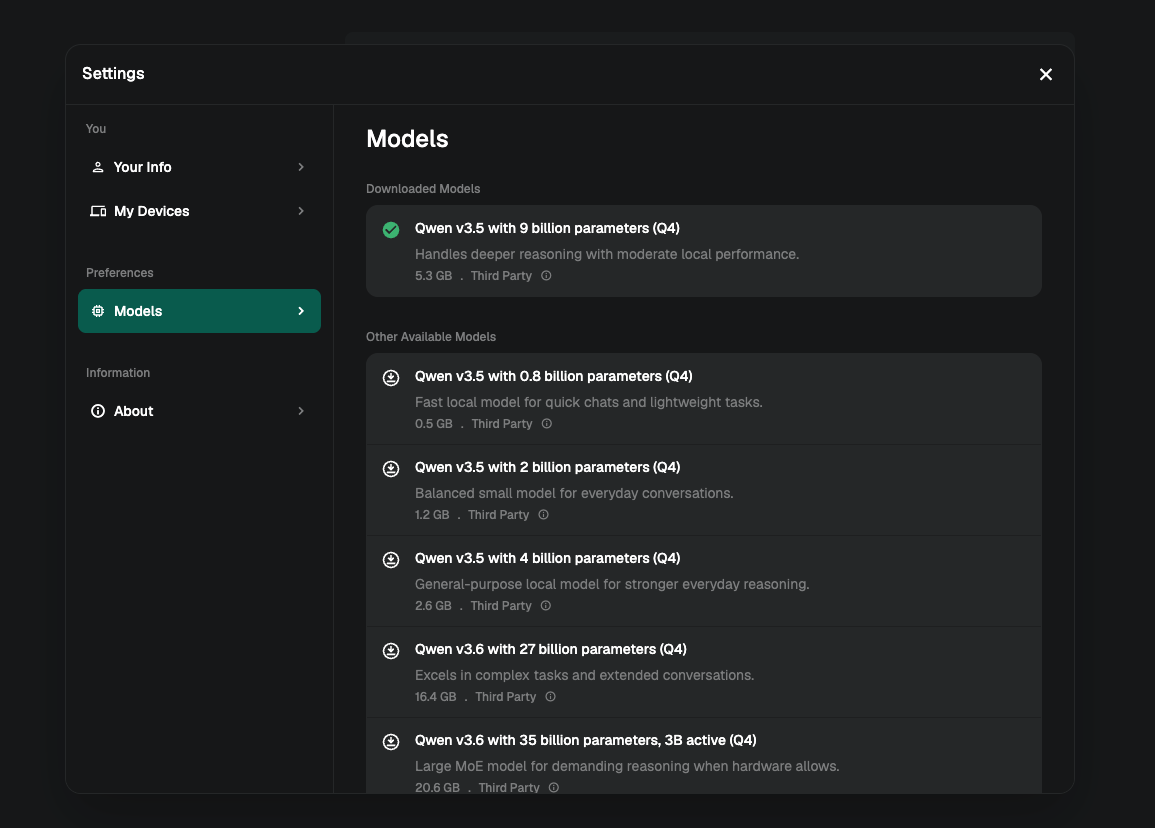
I looked into what QVAC actually runs. It is built on the llama.cpp ecosystem and executes both inference and on-device LoRA fine-tuning through Vulkan, so it spans AMD, Intel, NVIDIA, Apple Silicon, and mobile chips like Qualcomm Adreno and ARM Mali. Today it runs the general-purpose Llama, Qwen, and Gemma families, so the runtime itself is general, not single-domain. This is worth flagging, because the current model catalog makes it easy to misread: the first models Tether has actually published on QVAC are medical (its MedPsy family, fine-tuned from Qwen3), and one of its showcase apps is a privacy-first health assistant. The platform is general-purpose; Tether's own early models simply lead with healthcare. Because llama.cpp sits underneath, other open models in GGUF format run too.
The honest catch is size: the full DeepSeek, GLM, and Kimi flagships are far too large for a phone, but their smaller and distilled variants already fit, and several of those distillations are themselves built on the same Qwen backbone QVAC supports natively.
"This pairing, edge runtimes like QVAC plus open-weight models such as DeepSeek, GLM, Qwen, and Kimi, will end up more widely used across the world than the expensive frontier APIs from Claude, xAI, and OpenAI. Not because the frontier models are worse, but because free, private, and local wins the long tail."
Tether Evo and Tether Investments: the equity arms
These are two separate arms, and it's an easy pair to mix up. Tether Evo is the actual fifth pillar: a narrow, frontier-technology division built around neurotechnology and human-machine interfaces. Its flagship and so far only publicly named position is a $200M majority stake in Blackrock Neurotech, a brain-computer-interface company (unrelated to the asset manager of a similar name) working on communication, rehabilitation, and cognitive enhancement.
Tether Investments is a different, much larger vehicle, also funded from stablecoin profit but run outside the five branded pillars, that holds the rest of Tether's equity portfolio: over a hundred positions and counting. A sample of where that money has gone shows how far outside crypto it reaches.
| Company | Industry | Tether's position |
|---|---|---|
| Rumble (RUM Group) | Media / video platform | 48.7% stake, after Rumble's acquisition of Northern Data |
| Anchorage Digital | Crypto banking | $100M equity investment; also USAT's regulated reserve issuer |
| Adecoagro | Agriculture | 74.8% controlling stake |
| Twenty One Capital | Bitcoin treasury | Controlling stake, after buying out SoftBank's ~26% |
| Juventus FC | Sports / football | Over 10% of shares, second-largest holder after Exor; its ~€1.1B bid for a controlling stake was rebuffed in 2025 |
| Gold.com | Precious metals retail | $150M for ~12% stake |
| Dreamcash (Supreme Liquid Labs) | Hyperliquid-based RWA perps | Strategic investment; already runs USDT0-collateralized perps on Tesla, Nvidia, and other names |
Beyond the five pillars: the wider USDT ecosystem
The ecosystem doesn't stop at what Tether owns and brands. Around the five pillars sits a wider economy of chains and businesses that run on USDT, some backed by Tether or its sister company, some entirely independent.
- Plasma and Stable are two blockchains purpose-built to give USDT a payments-first home, both backed by Tether or sister company Bitfinex as investors. Plasma's own site counts $2.75B+ in onchain liquidity today.
Plasma's partner roster is the more convincing evidence: 146 companies across five categories, and the names are not niche. A sample, grouped the way Plasma itself groups them:
Three honest caveats belong next to that picture.
- Worth knowing, not worth over-indexing on: Plasma's DeFi-protocol TVL specifically has cooled since its October 2025 incentive-campaign peak, a familiar pattern once early rewards taper off. The underlying liquidity and partner relationships above are current and real.
- Stable took a slower, less dramatic path and is still early in its own growth. Its pitch is worth understanding though: a chain where USDT is the native gas asset, plus StablePay for consumers, aimed at the same job Stripe's Bridge does at the API layer, making stablecoin payments feel like ordinary payments for businesses. Same demand, attacked at the chain level rather than the orchestration level.
- Aster, a top-tier derivatives exchange, is USDT-heavy purely by its own team's choice, with no formal relationship to Tether at all, a genuinely independent bet that happened to align.
What I would focus on
This section is my own list of priorities: the specific things I would personally love to focus on if I were working inside the ecosystem, based on everything mapped above.
Three tiers: deepen what's already proven, claim the white space nobody has taken, and set up the longer game.
Deepen what's already working
The fastest wins are extensions of things already carrying real volume.
- Remittances. LemFi, a London-based remittance app backed by Tether, already moves USDT behind the scenes for customers across Africa and South Asia, but today the dollars turn back into local currency at the end of every transfer. The lean-in is the receiving side: co-design a "receive in digital dollars" option, where a LemFi transfer can terminate in a tether.wallet balance (a [email protected] username) instead of a bank account or cash pickup. The sender's experience stays identical; the recipient gets a choice they've never had: cash out now, or hold dollars. Every recipient who chooses to hold skips the off-ramp cost entirely (see the ramps section above), becomes a wallet user feeding the 150-million target, and gains a reason to keep spending those dollars directly rather than cashing out (see the merchant ideas below).
- Grow WDK the way you grow a developer platform. The Wallet Development Kit (above) is Tether's most under-marketed asset: it hands anyone self-custodial, multi-chain payment rails, Swidge-style DeFi access, and agent-ready wallets for free. Treated like the developer platform it is, it compounds. Concretely: showcase real community integrations so builders can see what is possible, run integration hackathons aimed at the Swidge and Lending modules, and give hands-on onboarding to the small and mid-sized businesses willing to embed it (white-label wallets, in-app payments, remittance flows). Every serious integration is a new distribution surface for USDT that Tether did not have to build or operate.
- Perpetuals. Deepen the relationship with Aster, currently an independent bet, rather than only benefiting from its choice to be USDT-heavy, and explore bringing that engine natively onto Plasma.
- Put Tether's megaphone to work. Tether already has the cheapest growth levers in the ecosystem sitting half-used: a developer grants program, co-marketing through its own channels and Ardoino's enormous reach, and the distribution power of a 570-million-wallet ecosystem. Systematically pointing those at ecosystem partners and community projects (the t402 builders, the teams behind confidential USDT, Plasma's app developers) would compound the whole ecosystem's growth at almost no cost. Nothing new needs to be built; it's attention, grants, and ad-hoc support, applied deliberately instead of occasionally.
Claim the open white space
These are gaps where demand is already proven and Tether is absent, underweight, or sitting on an unused advantage.
- Tokenized equities. Ondo, Backed's xStocks, Securitize, and Dinari lead the category, but Hadron already has real, working case studies: Quantoz's MiCA-compliant digital money issuance, Mikro Kapital's tokenized microfinance bond program for underserved small businesses, and Liquid Network's confidential RWA tokenization. Tokenized stocks inside tether.wallet is tempting but not obvious: this is exactly where the Latino grandma test fails, and bolting an investing product onto a radically simple wallet risks breaking what makes it work. One way to square it: a user-type selection at setup (simple by default, an investor mode you can switch on later), so complexity is opt-in rather than ambient. Using tokenized stocks as collateral for loans could be a huge win too, a real case for tokenization's ability to unlock liquidity.
- Agentic payments. USDC settles roughly 98% of measured AI-agent payment volume today, through Coinbase's x402 and Solana's new Pay.sh gateway. USDT is close to absent, not for lack of demand but because of one technical standard its contract never implemented. The wallet layer is already solved: WDK ships agent-ready, self-custodial wallets out of the box (see above), so the gap is the payment standard, not the plumbing. Supporting the community-led t402 project directly, and building a genuine USDT-native agent marketplace to rival Coinbase's agentic.market, would turn a real gap into a real head start. Tether's own expansion team has said publicly that it expects real agent-payment use cases within years, not decades, and that it is already building technology for them.
- Privacy. A company called Bron is already paying real salaries in a confidentially wrapped version of USDT, built entirely by third parties with zero Tether involvement, organic proof of demand sitting there unmonetized. Aztec is the natural technology partner to build this properly, starting exactly where Bron has already proven it works.
- A Tether-backed insurance fund for onchain finance. The idea I find most interesting, proposed by an outsider (me): a dedicated fund, illustratively around $1 billion, that insures audited Tether-related applications (vaults, lending markets, WDK-based DeFi modules) against smart-contract failure or exploit. Trust in smart contracts is one of the biggest real blockers to mainstream adoption, and AI models getting better at finding vulnerabilities makes it worse, not better. The mechanics in one breath: Tether seeds the fund, partners building on Tether's tech and assets can commit to it too, an audit firm signs off before the fund insures anything, and per-user coverage is capped (illustratively $50,000), the way deposit insurance caps coverage per depositor. What users get is a trust anchor similar in spirit to a bank guarantee, something nobody in crypto offers at scale today. There may be internal policy reasons this is harder than it looks, and an insurance pool carries real risks of its own, but the structure is buildable, and Tether's balance sheet is one of the very few that could credibly carry it.
- tether.wallet for merchants. The closed-loop endgame from the ramps section needs a second side: places to spend digital dollars. The wallet may already technically work for a small merchant, but working and being built for the job are different things: invoice handling, receipts, simple bookkeeping exports, and whatever each market's regulatory regime requires for accepting payment in USDT. Worth a real exploration before building anything, since the requirements differ sharply by country, but every merchant who accepts USDT directly makes the off-ramp less necessary for everyone around them. The second lever is discovery: a lightweight promotions surface inside the wallet that highlights nearby merchants who accept USDT, USAT, gold, or Bitcoin, along with any deals they are running. That raises the everyday utility of holding a balance and tightens the same closed loop, since every place you can spend digital dollars directly is one less reason to ever off-ramp. Swidge makes the merchant side painless too: a shop can price in one asset while the customer pays in another, the swap handled invisibly.
- Education partnerships. Universities already teaching this material are an underused channel, and I can offer a very specific starting point. UNWE, Bulgaria's largest and oldest economics university, runs a one-year Master's program called "Cryptoeconomics and Blockchain," and Bithope Foundation, my own organization, is already listed among its industry partners, alongside Binance. This wouldn't be cold outreach: it's an existing relationship I could personally help extend into a direct Tether Edu partnership, a foothold at a serious academic institution rather than another one-off pilot.
The longer game
Two moves that would take years to mature, and could matter most.
- Canton Network. USDC already holds a structurally deep position there; USD1 has only announced an intention to follow, nothing live yet. A real opportunity for USAT, but a gate that's ajar, not wide open.
- Native USDT on Bitcoin, via the RGB protocol. Symbolically the most interesting move of all: USDT returning to the chain it started on in 2014, and the pieces are now in place. This is native issuance, not a sidechain and not a wrapped version: RGB v0.11.1 is live on Bitcoin mainnet, using Bitcoin's own UTXO model for privacy and settling instantly over Lightning. The commercial rollout is led by UTEXO, a Bitcoin-native settlement layer seeded with $7.5 million primarily by Tether itself, with tether.wallet support planned. Ardoino has called the move "coming home." As of late July, launch is expected within weeks.
On the Tether FUD: why I think the case is closed
I've been having this debate for a decade. In the Sofia Crypto Meetup community I run, the same commentary resurfaces every time the broader market gets shaky: Tether is a Ponzi scheme, the reserves aren't real, the collapse is one bad quarter away. I used to treat such claims as a sign of the Dunning-Kruger effect - community members with the least amount of information identifying Tether as the Achilles' heel of crypto. By 2026, I think three hard facts close it.
First, the stress test already happened. In May 2022, the Terra/UST collapse triggered the most severe stablecoin run in the industry's history to that point. (People often conflate this with FTX's collapse that November, which saw far smaller Tether outflows; Terra was the real test.) Tether processed over $7 billion in redemptions within 48 hours, and nearly $10 billion within two weeks, likely more than 10% of its total reserves at the time, while USDT briefly traded as low as $0.95 before recovering its peg. It honored every redemption request. No bank on earth survives a same-speed, double-digit-percentage deposit run without a bailout or a suspension of withdrawals. Tether did it with neither.
And May 2022 was not a one-off. Tether has now operated through three full Bitcoin boom-and-bust cycles (2017-18, 2021-22, and 2024-26), on top of launching straight into the tail of the 2014-15 bear market. Its deepest wobble ever came in October 2018, when Bitfinex insolvency fears pushed USDT to roughly $0.88-0.92; it recovered within days, and redemptions never stopped. Meanwhile, each of those cycles erased funds, exchanges, lenders, and rival stablecoins that were supposed to be safer: Terra, FTX, Celsius, Three Arrows Capital, and dozens more. That is a massively strong Lindy effect: every stress test USDT survives makes the next one more survivable, and at this point it has survived everything the industry could throw at it.
Second, the sheer size of the Treasury position. Roughly $140.6 billion in US Treasuries makes Tether approximately the 18th or 19th largest holder of US government debt in the world, ahead of Germany, the UAE, and Australia. A company holding more US government debt than most of that debt's own G20-adjacent allies is not an entity anyone can quietly make disappear, and not one whose reserves can be waved away as imaginary while the Treasury market absorbs them every quarter.
Third, the market has already told us what happens when Tether closes the remaining questions. On March 24, 2026, Circle's stock fell roughly 20% intraday, partly on draft CLARITY Act language restricting stablecoin yield, but also explicitly on the news that Tether had engaged a Big Four firm for its first full audit. Investors have effectively been pricing Tether's remaining transparency questions as Circle's competitive moat. That prediction played out fast: by August 2026 the audit itself was done (see the reserves section above), removing the exact objection Circle's stock move was pricing in.
To be clear about where I stand: a full independent audit has now happened, and it mattered more than I expected it to. But on the S&P downgrade itself, I side with Tether's own read. A rating model that penalizes bitcoin and gold in the reserves has to be weighed against a decade of USDT redeeming at par through every real stress test the market has thrown at it, and to me the track record is the stronger evidence. Either way, that is a different conversation from "it's fake." By 2026, Ponzi-tier Tether FUD reads less like due diligence and more like a holdover from an earlier, thinner-capitalized era of the company, kept alive mostly by people who haven't checked the current numbers. Whatever else you conclude about Tether, at this point it is functionally too big to fail.
The conglomerate nobody's covering
"Tether is not a stablecoin company. It used a stablecoin to build something the financial system has no name for yet." Marieke Flament, former Circle executive
A hundred-plus companies under a separate investment arm. Five branded pillars spanning finance, mining, AI, education, and neurotech. Two new blockchains. A wallet. A tokenization arm. All of it funded from one product's profit, and most of it barely covered anywhere outside crypto trade press. That's the piece worth remembering next time someone calls Tether "just a stablecoin issuer."
Published July 2026 · Original ideas, structure, research, and writing: Vladislav Dramaliev (with Claude Sonnet 5)
← Back to bithope.org