
Contents
- Most tokenization happens where retail can't see it
- Three ways to put an asset onchain
- Five questions, in this order
- The five questions are a loop
- Question two: what does the law allow?
- Questions three and four: who issues, and why a token?
- What is onchain today
- Not every company wants its shares tokenized
- Question five: who holds it?
- Why would retail want a tokenized asset?
- Who is doing what
- Europe: shares and solar pass, property struggles
- The tokenization test
- The perfect tokenized asset may never exist
- The perfect tokenized asset: my scorecard
- Who can stop your token?
- If I were launching a tokenization chain
- A chain token: asset or liability?
- The edge is what others don't do
Tokenization Is Easy. Choosing the Asset Isn't.
Five questions to ask before tokenizing anything, and what they mean for anyone launching a tokenization chain.
Last month in Lugano, at the Future of Capital Markets conference, Adam Lawrence, co-founder and CEO of rwa.xyz, put the value of tokenized assets onchain at $30 to 40 billion. Against global finance, he said, that "effectively rounds to zero".[1] That matches rwa.xyz's count of distributed assets, tokens that can move between wallets: $39.8 billion on 12 November, leaving out stablecoins. Add represented assets, which never leave the issuer's platform, and it's about $418 billion.[2]
In October, Broadridge's Distributed Ledger Repo processed $345 billion of repo a day on average.[3] On a private ledger. That's tokenization at real scale, and no retail investor will ever see it.
For me, that contrast is the whole story. This piece is about the retail side: assets that ordinary investors would hold, trade or borrow against. Institutions tokenize for other reasons, such as faster settlement and moving collateral more cheaply, and that's a different piece. Putting an asset on a blockchain isn't hard anymore. The technology is close to a commodity. The hard part is answering five questions in the right order, starting and ending with your users. Below I look at what's being tokenized today, run it through that test, explain why the perfect tokenized asset doesn't exist, and end with what I'd do if I were launching a tokenization chain.
Most tokenization happens where retail can't see it
Last month, at a blockchain education conference at the University of National and World Economy in Sofia, a speaker from a bank had a whole slide on tokenization. She meant something else entirely: swapping card numbers and customer details for random tokens in the bank's back end, for security. Same word, different world. Here, tokenization means representing an asset (a bond, a fund share, a stock) as a token on a blockchain.
Even then, two things decide what you actually own. The first is legal. Most tokens today are a claim on something held somewhere else. Robinhood's stock tokens, for example, are debt securities issued by a company in Jersey, the offshore financial centre in the Channel Islands. They give you no rights in the underlying shares.[4] A few countries allow native issuance, where the token itself is the register of ownership. Germany does it with its electronic securities law (eWpG), France with its DEEP regime.
The second is access. rwa.xyz splits tokenized assets into "represented", where the token never leaves the issuing platform, and "distributed", where it can move between wallets.[5] I'd split distributed once more. A token that only moves between approved, identified wallets is a very different thing from one you can send to anyone.
Three ways to put an asset onchain
rwa.xyz splits tokenized assets into represented and distributed. I split distributed further, into whitelisted and open.
Represented
A record on a ledger. The token never leaves the platform.
- Leaves the platform
- Wallet to wallet
- Usable in DeFi
Distributed, whitelisted
Moves onchain, but only between approved, identified wallets.
- Leaves the platform
- Wallet to wallet (approved only)
- Usable in DeFi (permissioned pools)
Distributed, open
Once minted, it moves like any other token.
- Leaves the platform
- Wallet to wallet
- Usable in DeFi
Most tokenization happens where retail can't reach it. The deepest change is inside market plumbing run by incumbents like DTCC, Broadridge, JPMorgan's Kinexys and the European Central Bank's Pontes. Retail investors feel it last, and only indirectly. I wrote about this in July:
The Biggest Blockchain Story Is the One Crypto Chads Don't SeeTokenization is rebuilding the machinery of global finance. Here is who is doing what, and on which chains.linkedin.com · Vladislav Dramaliev · July 2026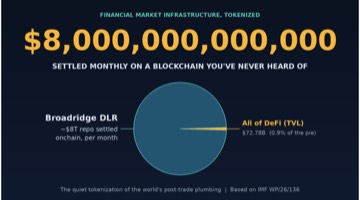
Five questions, in this order
When I look at a tokenization project, I ask five questions, in this order:
- What do your users want? What do they already do with their assets, and where do they get stuck?
- What does the law allow? Under which regime, and in which country, is it issued?
- Who issues it, and what problem does that solve for them?
- Why a token? What does it do that the ordinary form can't?
- Who holds it, and what will they actually do with it?
Users come first because they set the goal. The law comes second because it draws the box everything else has to fit in. It decides who may issue, who may buy, how much can be raised and where the token can trade. That doesn't mean you only build what the rules happen to allow. It means you know the box before you design the product, because the rules can quietly kill the business case.
The five questions work as a loop, not a checklist. Questions two to five leave you with a product you can actually build. Then you go back to question one: does it match what your users asked for? If it does, launch it. If it doesn't, go round again, or, if the law is what stands in the way, work to change it.
The five questions are a loop
Questions two to five turn what users want into something you can build. Then you check it against question one.
Answering question one. Listen to two signals. Some users tell you directly: they already do something in DeFi, like borrowing against their crypto, and ask for it inside your wallet. Others never ask, but their behaviour shows the same need: funds moved off the platform, workarounds, features they use elsewhere. Requests tell you what to build. Behaviour tells you how many people actually need it. I come back to how I'd test this at the end. One distinction matters here. Question one is about your platform's customers as a whole. Question five is narrower: who would hold this specific asset, and what the token lets them do with it.
Question two: what does the law allow?
In Europe, this is where it gets hard.
Stablecoins can't pay interest. MiCA, the EU's crypto regulation, bans it in Articles 40 and 50.[6] A tokenized money-market fund can pay it, because it's a security, not a stablecoin. It looks like a small detail. It decides which products can exist at all.
Securities law is fragmented. Germany, France and Luxembourg disagree on the moment a tokenized security actually changes owner. And a tokenized security is still a security, so raising money from the public with one is capped like any other. A licensed EU crowdfunding platform can raise up to €5 million per company over 12 months.[7] The new small-offer exemption allows up to €12 million without a full prospectus, and member states can lower that to €5 million.[8]
There's a fix on the table. Euroclear and Clearstream have proposed an optional EU-wide "28th regime" for tokenized debt securities: one rulebook issuers could opt into, next to the 27 national systems.[9] It's an idea I like, and one others in the industry have argued for well. I don't doubt the idea. I doubt the politics: 27 national systems, and the registrars and intermediaries built around them, would have to give ground. That two of the biggest incumbents are behind it is a good sign. If I were championing it, I'd map who still stands to lose and bring them in first.
Compliance costs are mostly fixed. This is the point I think gets missed. A prospectus, a licence and legal opinions cost about the same whether you raise €3 million or €300 million. So they hit the smallest issuers hardest. That's awkward, because easier access to capital for small companies is one of the benefits often promised for tokenization, by the OECD among others.[10] In its proposal to reform the DLT Pilot Regime, the European Commission itself named the compliance burden on smaller firms as one of the main obstacles. It proposed a lighter regime for small operators.[11] That has yet to materialize: the proposal is still being negotiated.
Questions three and four: who issues, and why a token?
Here's what is onchain today, leaving out stablecoins.[12]
What is onchain today
Distributed tokenized assets by class, excluding stablecoins. Total $39.8B.
Each asset class answers "why a token" differently.
- US Treasuries ($14.7B) lead because they're yield-bearing dollar cash that moves around the clock. A tokenized Treasury fund can sit on an exchange as collateral and keep earning interest. Crypto.com, Deribit and Binance have all accepted BlackRock's BUIDL fund that way.[13]
- Credit ($8.1B) connects real-world borrowers with onchain lenders. A platform raises stablecoins onchain, lends them to a business, passes on the interest and keeps a fee. The yield is real. So is the default risk.
- Commodities ($5.1B) are mostly gold. You can hold a fraction, trade it any time and keep it in your own wallet. You also buy and sell close to the market price, without the dealer markups of physical gold, where even the bar or coin you pick moves the price.
- Active strategies ($4.6B) are tokenized funds whose managers trade actively, hedge-fund style, rather than hold one asset.
- Stocks ($3.7B) promise 24/7 trading and access from outside the US. For me, the bigger use is putting them to work: as collateral, or to earn a yield paid in the same stock.
Now look at the bottom of the chart. Real estate, the asset most people picture when they hear "real-world assets", is $225 million. That's 0.6% of the total.
Tokenized stocks raised another question this year: is the issuer even the company? Under the US Securities and Exchange Commission's "innovation exemption" of 17 September 2026, third parties may tokenize US-listed stocks without the company being involved. The company has 30 days to object.[14] Not everyone is happy about it.
Not every company wants its shares tokenized
You can tokenize almost anything. That doesn't mean you should, or that the company agrees.
OpenAI · July 2025
Said Robinhood's "OpenAI tokens" were not OpenAI equity and that it never approved any share transfer.
Anthropic · May 2026
Warned that any transfer of its shares without board approval is void, including via tokens.
AMC · Sep 2026
Its CEO objected to Robinhood issuing a token tracking AMC shares without the company's consent. Robinhood's reply: "send your lawyers".
Microsoft, Alphabet, Goldman Sachs · Oct 2026
Objected to their shares trading as tokens on OKXICE, the venue of OKX and the owner of the New York Stock Exchange. Sixteen companies had objected within days; SpaceX followed in November.
I understand them. A token with a company's name on it, trading in a thin market, can drift away from the real share price. The company carries the reputational cost without having agreed to anything. Being able to tokenize something doesn't mean you should.
Question five: who holds it?
I see five reasons a retail investor would want a token instead of the asset itself: 24/7 access, use as collateral, yield, open access and, for crypto investors, keeping capital onchain. That last one is crypto-specific: if most of your capital is already onchain, you'd rather buy the asset there than cash out to a bank, wait for the transfer and deposit with a broker. Each one comes with a catch.
Why would retail want a tokenized asset?
If you can already buy the stock in your app, the token has to add something.
24/7 access
Real todayTrade outside market hours.
Collateral
EarlyBorrow against a stock or fund without selling it.
Yield
Real, as a fundTokenized money-market funds pay interest.
Open access
PartlyAnyone, anywhere, from any wallet.
Capital stays onchain
Real todayFor crypto investors: buy the asset with funds already onchain, without cashing out to a bank and depositing with a broker.
The catch that matters most is the simplest. Investors in Europe and the US can already buy Apple or Nvidia in apps like Revolut, Trade Republic or Bitpanda. A token of the same share adds nothing unless it adds utility.
Collateral is the first: borrowing against your stocks or funds without selling them. Kamino, a lending protocol on Solana, started accepting tokenized stocks as collateral in July 2025.[15]
Yield is the second: holding a stock and getting more of it over time. A vault at IPOR Fusion, where I used to work, does this with tokenized Nvidia on Base. It borrows dollars against the shares, lends them out, and pays the return back in Nvidia.
Nvidia Carry TradeDeposit tokenized Nvidia (NVDAc). The vault borrows USDC against it on Aave, lends it out on Morpho and Aave, and pays the yield in NVDAc. Curated by Tau Labs.app.ipor.io · IPOR Fusion vault on Base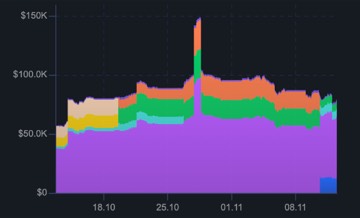
That yield always comes with extra risk. So the real questions are how the risk is managed, whether the return is worth it, and whether anything insures it. Answer those, inside a wallet people already know and trust, and that's the use case I'd build around.
Look at who is building and a pattern shows up.
Who is doing what
Retail platforms lead with US stocks; institutional players with funds and Treasuries.
Robinhood
Robinhood Chain · Arbitrum OrbitRetailStock tokens outside the US; debt securities from a Jersey issuer. Chain live 1 Jul 2026.
Kraken + Backed (xStocks)
Solana · Ethereum · BNBRetailTokenized US stocks and ETFs, usable in DeFi; also trade on Deutsche Börse's 360X venue. The London Stock Exchange plans its 100 largest companies as xStocks.
Coinbase
BaseRetailTokenized US stocks issued natively on Base since 24 Aug 2026 (Apple, Nvidia, Meta, Alphabet first), shares held via Alpaca. Non-US users in eligible countries.
Securitize
Multi-chainInstitutionalAgent for BlackRock BUIDL; EU DLT trading and settlement licence (Spain).
Ondo
Multi-chainBothTokenized stocks, Treasuries (OUSG) and yield (USDY).
21X
Polygon · StellarInstitutionalThe first EU venue licensed to both trade and settle tokenized securities under the DLT Pilot Regime (BaFin, December 2024).
Retail platforms lead with big US companies, institutional players with funds and Treasuries. European shares are only starting: the London Stock Exchange and Payward, Kraken's parent company, plan to bring London's 100 largest companies onchain as xStocks.[16]
Europe: shares and solar pass, property struggles
So far, what's onchain is mostly American. Europe is the gap, so here's how questions two to five play out on four European candidates that keep coming up in tokenization pitches. Question one depends on each platform's own users, so it stays out of the table. I've been specific about what exactly gets tokenized, because "tokenizing property" can mean ten different things.
The tokenization test
Questions two to five (Figure 2), applied to European candidates. Question one depends on each platform's own users.
| Question | European shares and indices | A solar or wind park | Small-business loans | Rental buildings |
|---|---|---|---|---|
| What is tokenized | A token tracking a listed share (say, a DAX company) or an index | A bond financing one specific project, not shares in the developer | A bond or loan note issued by one company, not its shares | Shares in a company (SPV) that owns one apartment or office building |
| Law | A security; usually issued as a tracker by a third party, as with xStocks | A bond under the same caps; Germany's eWpG allows native digital bonds | A security. EU crowdfunding licence up to €5M a year, or the small-offer exemption up to €12M | A security plus national property law |
| Issuer | A tokenization company or broker | The project company | A small business that needs credit | A property developer or manager |
| Why a token | Collateral and yield; the share itself is already in your app | Fund one project with income from selling power, in small tickets | Cheaper small raises, automatic interest payments | Small tickets, rent paid onchain |
| Who holds it | European savers who want to borrow against or earn on what they own | Local and retail investors who want green, steady income | Customers, local community, savers | Retail yield-seekers |
| Verdict | Clearest demand If the token does what the share can't | Strongest real-economy case Productive, pays the holder, clear payer | Debt yes, equity rarely Fixed compliance costs eat small raises | Yield first, exit at a discount Few buyers, so sales usually come below value |
Two results stand out. European shares and indices have the clearest demand, as long as the token does something the share in your app can't. And renewable energy is the most interesting to me. You're not buying shares in a listed solar company, which anyone can already do. You're lending to one specific solar park and getting paid from the power it sells. In April, a tokenized bond of up to €3 million did exactly that for the Ratekau solar park in northern Germany.[17]
Property is the weak spot, and fixed costs are only part of it. Each country keeps its own land register and property law, so the token usually sits on shares of a company that owns the building, not on the building itself. The price comes from an appraisal, not a market. And when you want out, buyers are few, so sales usually come below value.
The perfect tokenized asset may never exist
So what would the perfect tokenized asset look like? For me, it's natively issued, so the token is the ownership, and you keep it in your own wallet. It moves freely and trades on public decentralized exchanges against stablecoins, crypto and other tokenized assets. It works as collateral, and anyone in the world can get it. And nobody can freeze it, claw it back or declare it invalid.
Tether's CEO Paolo Ardoino made a related point on the Stephan Livera Podcast this month: stop tokenizing Apple shares, tokenize things that produce. His examples ranged from farmland and factories to forests and hydro power.[18] I agree with the direction. Shares are already digital. Productive real-world assets are where tokenization could open up something new.
Here's how today's assets score against my list. Bitcoin isn't a tokenized asset (it's native to its own chain), but it's the benchmark for what fully onchain looks like.
The perfect tokenized asset: my scorecard
My assessment. Bitcoin is not a tokenized asset; it is here as the benchmark for what "fully onchain" looks like.
| Asset | Productive | Pays the holder | Native | Self-custody | Free transfer | DeFi & collateral | Global access | No kill switch |
|---|---|---|---|---|---|---|---|---|
| Treasuries / money funds | ||||||||
| Private credit | ||||||||
| Tokenized gold | ||||||||
| US stocks (open tokens) | ||||||||
| Real estate, land, energy | ||||||||
| Bitcoin |
No real-world asset ticks every box. Bitcoin ticks most of them, but it funds nothing and pays nothing. The tokens that come closest on transferability are open stock tokens like xStocks, and they still aren't native, aren't open to everyone, and have an issuer who can pause them.[19]
That last column is the real obstacle.
Who can stop your token?
Every real-world asset has someone offchain who must honour the claim. That is where the kill switch lives.
Bitcoin
No issuer, no freeze.
Stablecoins
Issuers can blacklist and freeze addresses.
Tokenized gold
Paxos froze 11,184 PAXG tied to FTX (2022).
Open stock tokens
xStocks on Solana: the issuer can pause all transfers and move or burn tokens in any wallet.
Permissioned securities
ERC-3643: freeze, forced transfer, recovery by design.
Every real-world asset has someone offchain who has to honour the claim: a custodian, a registrar, a court. That someone can stop the token, and sometimes has to. Paxos froze more than 11,000 PAXG gold tokens tied to FTX on a law-enforcement order.[20] ERC-3643, a token standard for regulated securities, has freezing and forced transfers built in by design.[21]
With Bitcoin, code is enough to remove the kill switch, because there's nothing offchain behind it. With a real-world asset, it isn't. Even if the token's contract has no freeze function, the custodian can refuse to redeem it, or the company can declare the transfer void, as Anthropic did this year.[22] The kill switch just moves offchain.
What can shrink it is law. If the law says the token itself is the legal title, ownership moves with the token and no issuer can cancel it at will. It could only be overridden in a few cases written into law and applied to everyone, like theft, lost keys or a court order. That's the kind of rule a 28th regime could set, and it's why I think it matters.
I'm not sure the perfect tokenized asset can exist at all, at least under regulation as it's usually written. Control is often a requirement, not a bug: regulators want someone who can act on fraud, mistakes, lost keys and sanctioned wallets. So the realistic goal isn't zero control. It's narrow control, written into law, applied to everyone the same way, and visible to the holder before they buy.
If I were launching a tokenization chain
Many brokers and exchanges have launched their own chains, most often Ethereum layer 2s. They all need the same basics: a stablecoin that can be issued and redeemed natively on the chain, a secure bridge for value to flow in, partners with real products, and incentives to get started. Those are prerequisites, not a strategy. Everyone has them, so to a user the chains look identical. If I were launching tokenization at a regulated European broker with its own chain, I'd start from three hypotheses about what could make it different.
- Identity checks once, then everywhere. KYC done in the app carries over to the user's own non-custodial wallet. Then whitelisted assets stop being a dead end, and regulated DeFi becomes possible.
- Collateral from day one. Let people borrow against what they already hold, crypto first and then tokenized stocks and funds.
- European assets as the opening. This holds for a platform whose customers are mainly European. Users have to want it, so I'd test it rather than assume it. But tokenized European shares and indices that work as collateral, and ideally earn a yield, would give European savers a new reason to hold European companies. That fits the EU's own push to keep savings invested in Europe, the Savings and Investments Union.[23] Energy projects could follow.
Behind all three sits distribution. Robinhood and Kraken already have it, and any broker with millions of customers does. The question is whether those customers would start using the platform's self-custody wallet too, what would make them do it, and whether they'd recommend it to friends. That's what the three hypotheses are for. A large retail base and bank partners matter more than yet another issuance platform.
Who launches with you. Ideally, a working DeFi ecosystem from day one, not "coming soon". For me the foundations are five. A euro stablecoin, ideally issued natively on the chain; bridged in works too, just less cleanly. A bridge to bring other assets on. For a broker, the best bridge may be its own app: let users move selected assets from the app to their self-custody wallet, and liquidity arrives on day one. A DEX with real liquidity. A lending market on an established platform with a long track record, such as Aave, Morpho or Compound, where the chain's assets work as collateral. And oracles that price all of it. On top of that you need an issuer with a real asset. Vaults come next: strategies built on those markets, like the Nvidia vault above. Perpetuals and prediction markets are extras, not foundations. At æternity I saw what happens when the story launches ahead of the partners and the liquidity. You spend attention you can't buy back.
One flagship action, measured. Not "the chain is live". Pick one thing every user can do in the wallet on day one, like "borrow euros against your bitcoin" or "earn on a euro Treasury fund". It makes the launch easy to explain, and it gives you the measure: how many users did it, and how many still do it 90 days later. I'd set those targets before launch and judge the launch on them, not on week-one deposits.
A token with one clear job. Many chains also launch their own token, though broker-run chains like Robinhood's haven't so far. If you do, it can be your best asset or your biggest liability. At IPOR Labs, our token launch came with a liquidity mining campaign. Deposits went from $2.4 million to almost $43 million in about two months. Many of the people who came bought the token only to stake it, farmed the rewards, sold and left. I called them locusts. The industry calls it mercenary capital. Plasma, a Tether-linked chain, showed the same thing at scale in 2025. Token rewards pulled $6.6 billion into Aave's Plasma market within weeks of launch. Then deposits fell to about $1.7 billion.[24] It's one of many. Incentivized launches look like a huge success for exactly as long as the rewards last.
A chain token: asset or liability?
From my own incentivized DeFi launch: rewards that pay people for arriving attract people who leave.
Give capital a reason to stay. We did it differently at IPOR with Fusion, our later vault product, and deposits grew from $7 million to $67 million. There was a points programme, but I think it mattered least. The yield itself, transparency, trust in the curators running the vaults and a simpler interface did more. If you do pay incentives, reward capital that stays for three, six or twelve months. How much stays matters more than how much arrives.
How I would test it. These are hypotheses, not answers, so this is question one in practice. I'd run short interviews about what people actually do with their holdings today, and invite-only pilots before the public launch. I'd also listen to what bank partners keep asking for in business-development conversations, and to what the community complains about. When those point the same way, you have your launch.
The edge is what others don't do
Tokenization is easy. Choosing the asset isn't. For anyone launching a tokenization chain, what the others already do is only the starting line. The real work is finding what they don't do. Questions two to five tell you what's possible. Question one, asked again at the end, tells you what's worth building. Then commit to it, and use it to win new users and keep the ones you already have.
The perfect tokenized asset is a direction, not the goal. Productive, native, freely tradable, useful as collateral and impossible to switch off: nothing ticks every box today, and some boxes may never be ticked. The chains I'd bet on are the ones that keep moving towards it, one differentiated step at a time.
Glossary
- Active strategies
- Tokens giving exposure to actively managed strategies: hedge-fund-style mandates, basis trades and similar approaches (rwa.xyz category). Some other trackers do not count these as real-world assets at all.
- Arbitrum Orbit
- Technology for launching your own Layer 2 chain on Ethereum, built by Arbitrum's developers. Robinhood Chain uses it, the way other chains use Optimism's OP Stack.
- Base
- Coinbase's Ethereum Layer 2 chain, built on Optimism's OP Stack.
- Bitcoin as the benchmark
- Bitcoin is not a tokenized asset: it is native to its own chain, with nothing offchain behind it. It is in the table as the benchmark for what fully onchain looks like.
- BlackRock BUIDL
- BlackRock's tokenized US dollar money-market fund, run with Securitize. Only approved, KYC'd wallets can hold it.
- Collateral
- An asset pledged to secure a loan. If its value falls too far, the lender can sell it (liquidation).
- Commodities
- Mostly tokenized gold (for example PAXG and XAUT), each token backed by physical metal in a vault.
- Credit (private credit)
- Loans to businesses and other borrowers, made outside public bond markets and funded onchain. rwa.xyz splits it into four: asset-backed credit (loans secured by specific assets or receivables), specialty finance (niche lending such as trade finance), corporate credit (loans to companies) and diversified credit (funds that mix several types).
- Curator
- A professional risk manager that runs a vault: decides which lending markets it uses, on what terms (limits, caps), and adjusts as markets move.
- DeFi
- Decentralized finance: lending, trading and other financial services run by smart contracts on public blockchains instead of by a company.
- DEX
- Decentralized exchange: a trading venue run by smart contracts, where you trade from your own wallet without an account.
- Dilution
- New tokens printed to pay rewards reduce the share each existing token represents, which pushes the price down unless real demand grows as fast.
- Distributed asset
- A token that can move to wallets outside the issuing platform and between wallets, including tokens restricted by whitelists (rwa.xyz definition).
- DLT Pilot Regime
- The EU's trial framework (since March 2023) letting licensed venues trade and settle tokenized securities on distributed ledgers.
- ERC-3643 (T-REX)
- An Ethereum token standard for regulated securities. Every transfer is checked against an identity registry; the issuer's agent can freeze wallets, force transfers and recover lost tokens.
- EU crowdfunding licence (ECSP)
- The European Crowdfunding Service Providers Regulation. A licensed platform can raise up to €5M per project owner over 12 months, passported across the EU. An increase to €12M is being lobbied for, not adopted.
- Gas
- The fee paid to a blockchain to process a transaction.
- Kamino
- A lending protocol on Solana. In July 2025 it became the first major DeFi lender to accept tokenized stocks (xStocks) as collateral.
- Kill switch
- Any party that can freeze, claw back, force-transfer or cancel your token.
- KYC
- Know Your Customer: identity checks required by anti-money-laundering rules.
- Layer 2 (L2)
- A separate blockchain that processes its own transactions but settles them on Ethereum and relies on its security. Examples include Coinbase's Base, Kraken's Ink and Robinhood Chain.
- Mercenary capital
- Money that arrives only for incentives and leaves the moment they end or a better offer appears. Also called mercenary liquidity.
- MiCA
- The EU's Markets in Crypto-Assets Regulation. Articles 40 and 50 bar stablecoin issuers (and, for e-money tokens, crypto service providers) from paying interest.
- Money-market fund
- A fund holding very short-term, high-quality debt such as government bills. Low risk, pays interest. Tokenized, it is a security, so it can pay yield where a stablecoin can't.
- Native issuance
- The token is the legal record of ownership. No separate paper certificate or register stands behind it (possible under Germany's eWpG and France's DEEP regime).
- Non-US government debt
- Bonds and bills of governments other than the US, for example euro area T-bills.
- Oracle
- A service that brings outside data onchain, above all prices, so smart contracts such as lending markets can value collateral. For a real-world asset, it also carries the asset's price or fund value onto the chain.
- Pays the holder (yield)
- The holder receives income: interest, dividends or rent. Different from 'funds real activity': gold funds nothing and pays nothing; a Treasury pays you but mostly funds a government.
- Private equity / VC
- Stakes in funds that invest in private companies, from start-ups (venture capital) to mature firms (private equity).
- Productive (funds real activity)
- The money behind the token finances something that produces: a farm, a factory, a building, a business loan. An asset can be productive without paying the holder directly (for example growth stocks with no dividend).
- Repo
- A repurchase agreement: a short-term loan where one side sells securities (usually government bonds) and agrees to buy them back, often the next day. The backbone of short-term funding for banks.
- Represented asset
- A token that cannot leave the issuing platform or move between wallets. The ledger is onchain, but buying, selling and payouts still run through banks or other intermediaries (rwa.xyz definition).
- Self-custody
- You hold the asset in your own wallet, with your own keys, not at a broker.
- Small-offer exemption
- Under the EU Listing Act, public offers below €12M per issuer over 12 months can skip the full prospectus, from June 2026. Member states may lower the threshold to €5M.
- SPV
- Special purpose vehicle: a company set up to hold one asset, for example a single building, so investors own shares of that company.
- Stocks
- Tokens that track listed company shares. Most give price exposure, not the full rights of a shareholder.
- US Treasuries
- US government debt, mostly short-term bills, held through tokenized funds. The largest tokenized asset class.
- Vault
- A smart contract that pools deposits and runs them through a set strategy (lending, looping, rebalancing), usually overseen by a curator. Depositors get a token that represents their share.
- Wash trading
- Trading with yourself, or in a circle, to create fake volume. When a token rewards volume or fees with discounts or points, some traders churn trades just to harvest the rewards.
- Whitelist
- A list of approved, identity-checked wallets. The token's contract rejects any transfer to a wallet that is not on it.
- xStocks
- Tokenized stocks and ETFs issued by Backed and distributed by Kraken and others. Each token tracks a real share held by a custodian.
Sources
- Adam Lawrence (rwa.xyz) at The Future of Capital Markets, Lugano, Oct 2026. Cryptohopper News
- rwa.xyz Global Market Overview: distributed and represented asset value, 12 Nov 2026
- Broadridge: Distributed Ledger Repo processes $7.6 trillion in October (Nov 2026)
- Robinhood Assets (Jersey) Limited: stock token product disclosures
- rwa.xyz: tokenization types, distributed and represented assets
- Regulation (EU) 2023/1114 on markets in crypto-assets (MiCA), Articles 40 and 50
- Regulation (EU) 2020/1503 on European crowdfunding service providers
- Regulation (EU) 2024/2809, the Listing Act (prospectus changes apply from 5 June 2026)
- Euroclear: a 28th regime for tokenized debt securities (May 2026)
- OECD: The Tokenisation of Assets and Potential Implications for Financial Markets
- Taylor Wessing: DLT Pilot Regime reform (Jun 2026); Regulation Tomorrow on the Council position (Oct 2026)
- rwa.xyz: tokenized asset dashboard, distributed value excluding stablecoins (23 Oct 2026)
- Cointelegraph: Deribit and Crypto.com accept BUIDL as collateral (Jun 2025); Binance followed in Nov 2025
- Gibson Dunn: SEC opens five-year sandbox for tokenized trading of NMS stocks (Sep 2026)
- The Block: Kamino integrates tokenized xStocks as collateral (Jul 2025)
- Payward and London Stock Exchange partner on tokenization (31 Aug 2026)
- Cashlink: tokenized capital market infrastructure on Stellar, incl. the Ratekau solar bond (Apr 2026)
- Stephan Livera Podcast, SLP786 with Paolo Ardoino (Nov 2026)
- Solana: xStocks case study (token controls)
- Paxos: freezing PAXG tokens related to FTX (Nov 2022)
- EIP-3643: T-REX, token for regulated exchanges
- Anthropic: unauthorized Anthropic stock sales and investment scams
- European Commission: Savings and Investments Union strategy (Mar 2025)
- Plasma: Aave on Plasma (deposit figures); DefiLlama XPL price history
Figures carry their own sources in each footer.